Showing posts with label National Park. Show all posts

Sunday, May 5, 2024

Birding Big Bend National Park

Though the total solar eclipse set the date of our trip to Texas, we had long wanted to go birding there.  We allowed time before and after the eclipse to visit some of the better known birding hotspots.  We began our trip, before the eclipse, by driving from Austin down to Terlingua, a community adjacent to Big Bend National Park and spent three days birding some popular hotspots in the park:  Sam Nail Ranch, Rio Grande Village, Dugout Wells, Cottonwood Campground, and the Chisos Mountains Basin.

We stayed at sleeper cabins that had no potable water, so it was a good thing we had brought our own water.  The weather was a big change from Idaho where there was still snow on the hills out our window.  Ninety degrees with hot dusty winds gusting to 40 miles per hour was our experience.  At night, the turkey vultures flew in to roost on a cell tower near our lodging.  At dawn, seen below, they stretch their wings to warm in the morning sun.


Our first stop was at Sam Nail Ranch.  Tired from traveling, we were not the early birds, and it was afternoon by the time we walked the trail.  


This colorful lizard was well-adapted to the hot, dry life.


We proceeded on to the Rio Grande Village campground where we were greeted by the begging Greater Roadrunner.  They seemed very acclimated to campground life.


A Ladder-backed Woodpecker was foraging the in the trees.


The next morning while we sat outside our cabin, enjoying the cooler morning temperatures and drinking coffee, we observed a Lark Bunting foraging nearby.


Our second trip into the park took us to the Visitor Center, where this Curve-billed Thrasher was seeking shade and very audibly calling.


We proceeded to Cottonwood Campground, where some helpful birders pointed out the Common Black-hawk, behind the sign that said, "No entry, Black-hawk Nesting Area".
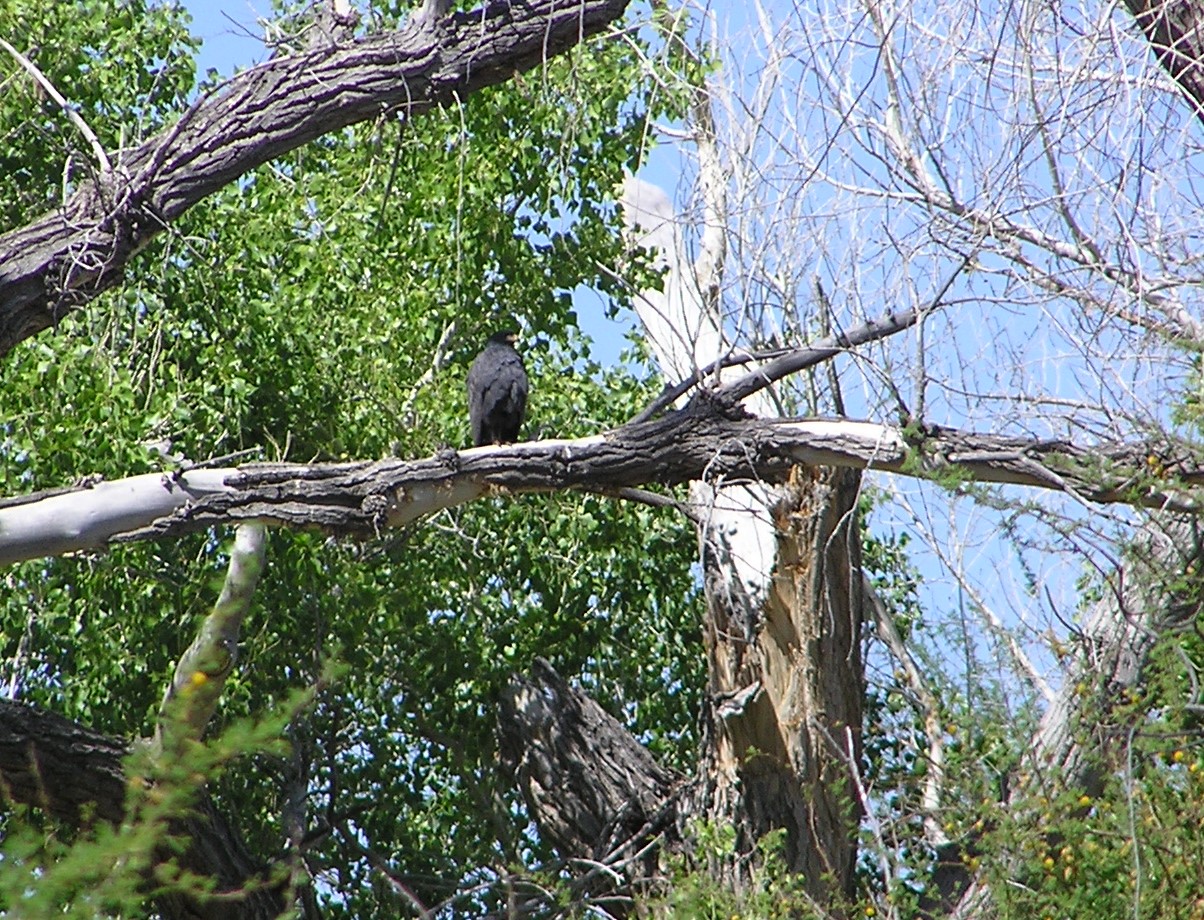

There were also numerous Gray Hawk residing there.


And, Vermillion Flycatchers everywhere.

On our third and final day visiting Big Bend, we first went early (relatively speaking, early for us) to the Dugout Wells area, which was rich with birds even at the hour we arrived.  Bell's Vireo were prevalent.


We then went to wait in line to be permitted to drive up to the Chisos Basin.  The parking is limited there, so when a car came out, another was allowed to drive up.  This was confusing to those at the back of the line, as there was only one volunteer at the head of the line and no explanatory signage.  I did some volunteer work for a while, going to each new arrival and explaining the options which included driving to the head of the line and making a left turn to drive back down the road if one was not interested in the roughly 20-minute delay.


Saturday, May 31, 2014

Yellowstone National Park Geothermal Features

I have had the good fortune to visit Yellowstone National Park on more than one occasion.  I had a roommate who made an annual pilgrimage to the Park on the final weekend it was open, before the winter closure takes effect.  The crisp autumn air accentuates the steaming geothermal features.  Elk bugle and lock horns in their dominance displays.  It is not so crowded at the end of the season.


In addition to geysers, there are mud pots that bubble and roil like a pot of boiling water.  Every so often a big wad of mud is hurled into the air and I dubbed those "mud frogs."


By first light, every small fumarole stands tall and magnificent.


These stark tree trunks are the remains of trees killed as the hotspot evolves and moves.  Geothermal systems are not static, and when there is an earthquake some geothermal features disappear and new ones appear at the ground surface.  The sentinels stand with their roots in hot mineral water and the trunk act as a wick, drawing the minerals into the wood.  If you ever wondered about the origins of petrified wood, you're seeing it being created here.


Saturday, December 28, 2013

Government Shutdown, Tea Party violates contract with America


My enthusiasm for blogging was dampened by the frustration I experienced, after planning a vacation for a year, expending significant time and money to travel to Maine (including purchasing an "America the Beautiful" pass to our public lands for $80) only to find that due to the Tea Party Government Shutdown the promise made to me at the time I purchased this pass was not to be honored.

Sunday, September 15, 2013

Mt. Rainier National Park

On the homeward leg of our vacation, we camped just outside of Mt. Rainier National Park.


When we awoke the early morning light was reflecting off this stream.


We drove up to Paradise, and stopped on the way to look down into the steep canyon carved by the dark, silty glacier meltwater that feeds the Cowlitz River.  It was well over 100 feet below the bridge to the water.


Though you can't see it in this image, the canyon is just at the left of this meadow, and the meadow sits on solid rock polished smooth by glaciers.


Mt. Rainier is covered in snow and blue ice glaciers, and the water from melting snow and ice cascades in rivulets and waterfalls.


Tiger Lily. Lilium columbianum.  With beargrass in the background.  The wildflowers were an astounding symphony of color.

Wednesday, September 11, 2013

Olympic National Park

Cyndi and I visited the Olympic National Park, Dungeness Spit, Cape Flattery, and the Olympic Peninsula in northwestern Washington this summer.  I saw a new life bird there, the Rhinoceros Auklet.


I saw many Heerman's Gulls.


Our favorite bird, though, has to be the characterful puffins.  The puffins there are the Tufted Puffins.  I had never seen one this close before!


We spent an enjoyable day hiking on Dungeness Spit, and this view shows the lighthouse at the tip of the spit with Mount Rainier in the distance.


untitled                


Here is a veiw of the spit.  It is about five miles out to the lighthouse.


We also went to the Hoh rainforest.


Moss covers everything in this area where there can be about 180 inches of rain every year.


We also stopped at a few of the many beaches on the Pacific coast.  The beaches further north were composed of cobblestones.


There were not very many people out in the early morning.


Driftwood was piled high, and this particular image caused me to imagine animal faces looking out to sea.


Further south, the beaches become broad expanses of soft sand.


This trail to the beach winds through a grove of Sitka Spruce, and many of them have burls growing on them.


The sandy coastline goes on for miles, and camping is allowed on many of the beaches.


Pearly Everlasting grew at the edge of the sand.


There were interesting bits of shells left behind by the receding tide.


Saturday, September 7, 2013

North Cascades National Park

This year Cyndi and I drove to North Cascades National Park.  On the way there we saw this Eastern Kingbird, in northern Idaho.


We camped in the Cascades, and this Swainson's Thrush was one of many heard calling in the morning.


There were many Townsend's Warblers.


This was the view from our tent.


Diablo Lake, really a reservoir behind a dam, gains its interesting color from the fine suspended sediments called glacial flour.


Thursday, June 17, 2010

Saguaro National Park

We visited Saguaro National Park on our way to Las Vegas.

The Saguaro stretch for miles. These are some very old cacti.

When they die they leave these skeletons in the hot sun.

In the mornings they were covered with large white flowers with yellow centers.

I already showed this petroglyph with a picture of a California Bighorn Sheep at the Arizona-Sonora Desert Museum ... but this was just one of a large assortment of these rock writings.

Here's a view from a bit further away.

And further still. I imagine the creators of this rock art must have done it in the wintertime, when the temperatures would have been more conducive. It was quite hot while I was there. Maybe above 90 degrees.

We drove on a dirt road through Saguaro National Park, which I'm not easily persuaded to do with my street car. The road was in fairly good shape. We saw some birds in the Mesquite and stopped to investigate. Though quite far off they were obviously Gnatcatchers with a black cap. Sorry they're so hard to see in this photo, but it was exciting to see the Black-tailed Gnatcatcher for the first time. They didn't seem to mind the hot and dry desert environment.

As this lizard ran across the road it curled it's striped tail forward over its back. Both Cyndi and I immediately thought it was a scorpion. It really had the mimicry perfected.

And, my favorite image from this hot, dry place ... even here hummingbirds thrive. The Costa's Hummingbird lives in the desert and displays a gaudy purple moustache-like gorget.