I have had the good fortune to visit Yellowstone National Park on more than one occasion. I had a roommate who made an annual pilgrimage to the Park on the final weekend it was open, before the winter closure takes effect. The crisp autumn air accentuates the steaming geothermal features. Elk bugle and lock horns in their dominance displays. It is not so crowded at the end of the season.
In addition to geysers, there are mud pots that bubble and roil like a pot of boiling water. Every so often a big wad of mud is hurled into the air and I dubbed those "mud frogs."
By first light, every small fumarole stands tall and magnificent.
These stark tree trunks are the remains of trees killed as the hotspot evolves and moves. Geothermal systems are not static, and when there is an earthquake some geothermal features disappear and new ones appear at the ground surface. The sentinels stand with their roots in hot mineral water and the trunk act as a wick, drawing the minerals into the wood. If you ever wondered about the origins of petrified wood, you're seeing it being created here.
Saturday, May 31, 2014
Monday, May 26, 2014
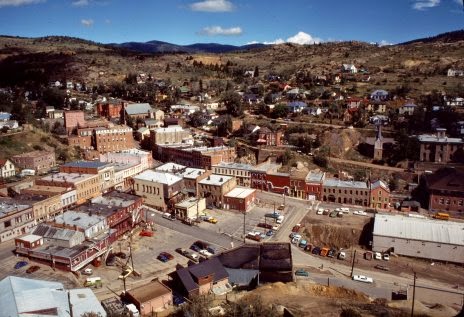
Central City, Colorado
I worked during two summers, my junior and senior year of college, in Central City, Colorado. I was head usher at the Central City Opera House, the second-oldest opera house in the United States. After the season ended I remained on to serve as a tour guide in the Teller House Hotel, known in its day as the finest accommodations between St. Louis and San Franciso. President U.S. Grant stayed there. OK, so he slept off the results of a drinking binge. He certainly did lie down on a bed for a while.
The City of Central is home to the "Richest Square Mile on Earth." By which it is meant that more precious metal was extracted from that square mile than anywhere else. It was rich in gold and silver, and was even the source of the yellowcake Madame Curie used to do her experiments on radioactivity.
The entire town is a National Historic District.
Jack Kerouac visited and wrote about his experience in On the Road. Bob Dylan performed there, and was booed off the stage. Gambling was legal, then it was not, and now it is once again. It's like going to Disneyland with bars. Lots of bars. I was too young to drink, so the bars did not impress me one way or another.
At 8,500 feet elevation, and a short walk to a stunning view of the Continental Divide, this was an idyllic place to work for the summer. The photo below is the view from Longs Peak. Longs Peak is the most-climbed of Colorado's 14,000 foot peaks, and I did climb it with my friends.
I climbed James Peak a couple of times. James Peak is over 13,000 feet in elevation and the tiny alpine wildflowers, like this Alpine Spring Beauty reward the effort.
Claytonia megarhiza
The City of Central is home to the "Richest Square Mile on Earth." By which it is meant that more precious metal was extracted from that square mile than anywhere else. It was rich in gold and silver, and was even the source of the yellowcake Madame Curie used to do her experiments on radioactivity.
The entire town is a National Historic District.
Jack Kerouac visited and wrote about his experience in On the Road. Bob Dylan performed there, and was booed off the stage. Gambling was legal, then it was not, and now it is once again. It's like going to Disneyland with bars. Lots of bars. I was too young to drink, so the bars did not impress me one way or another.
At 8,500 feet elevation, and a short walk to a stunning view of the Continental Divide, this was an idyllic place to work for the summer. The photo below is the view from Longs Peak. Longs Peak is the most-climbed of Colorado's 14,000 foot peaks, and I did climb it with my friends.
I climbed James Peak a couple of times. James Peak is over 13,000 feet in elevation and the tiny alpine wildflowers, like this Alpine Spring Beauty reward the effort.
Claytonia megarhiza
Sunday, May 11, 2014
Wildflowers
Here are some wildflowers I have seen and photographed. When I went to college, I believed I wanted to be an interpretive naturalist working in the National Park system. It seemed a very fun thing to do, based on my experience as the recipient of the guided walks given by naturalists. I even worked in Acadia National Park one summer, employed by the Department of Interior, National Park Service. It was a lot of fun.
When I attended college I studied Plant Ecology, Plant Natural History, Coastal Plant Ecology (a graduate level course with Dr. Paul S. Godfrey), and Ecology (with Dr. Lincoln P. Brower, the Monarch Butterfly researcher). I was also interested in photography, and photographed wildflowers as I chanced upon them. Because of the science interest, I tried to identify the Latin names of the plants I photographed. Feel free to correct me if any of these are not accurate.
Arisaema triphyllum
Jack in the Pulpit
In the Massachusetts woods
Cornus canadensis
Dogwood
On the coast of Maine
Beach Pea
On the coast of Maine
North Carolina
Nebraska
Dodecatheon
Shooting Star
Idaho
Gilia aggregata
Scarlet Gilia
Allium acuminatum
Wild Onion
Sunflower
Round-lobed Hepatica
Massachusetts woods
Polygala paucifolia
Gaywings
Polygala paucifolia
Gaywings
Uvularia perfoliata
Perfoliate Bellwort
Massachusetts woods
Massachusetts woods
Houstonia caerulea
Bluets
This is one reason I did not want to mow the lawn in Maine.
Hieracium aurantiacum
Orange Hawkweed
Maine
Mimulus nanus
Dwarf Lewis' Monkeyflower
Craters of the Moon National Monument, Idaho
Cypripedium calceolus
Yellow Lady Slipper
Canada
Trillium ovatum
Trillium
Olympic National Park, Washington
Trillium erectum
Trillium
Massachusetts woods
Massachusetts woods
Calypso bulbosa
Calypso Orchid
Olympic National Park, Washington
Calypso bulbosa
Calypso Orchid
Olympic National Park, Washington
Friday, April 11, 2014
Winter on Bald Mountain
I spent a couple of decades of my life taking an early retirement as a ski bum in Idaho's Wood River Valley. As a youngster I grew up in Maine. Going out the door of my house I could go across the road, through the baseball field and cemetery and down the hill to the estuary. Or I could go up the road or down the road. Behind me lay the woods, which seemed endless, but in fact were really just swampy and not conducive to hiking. Down the road, toward the main highway (US Route 1) was an old vacant house, overgrown with tall grass. One day, after years of vacancy, a retired couple appeared and they could be seen moving in. The fellow got a lawn mower and worked to restore order to the overgrown yard. It took a lot of mowing. Then an ambulance pulled up, and took him away. Heart attack. My mother became friends with his widow.
This was my life lesson about the thing called "retirement." Retirement was a chancy thing. There are no guarantees except for those who create their own destiny. Some would say I invented "slacker" before the Me Generation became aware of it. I prefer to think that I invented the hedge fund. I placed my bets that I would have a retirement by taking it from age 18 to 36. The odds were good, and I won.
For the record, I paid my own way. When I say "slacker," I'm not talking about "freeloader," kids. I paid for my own college. All of it. Yes, parents and relatives extended me credit, and I have always repaid my debts. I rather loathe debt, actually. I was brought up not to be beholden. Nobody likes indentured servitude, even if it is an American institution. I had seasonal work, when it snowed, on Sun Valley's Bald Mountain. I had self-employment, as a photographer. When I got serious, at age 36, I went into part-time employment.
For the record, I'm now in wage-earner mode. A minimum of 40 hours per week, sometimes with overtime that once hit 70 hours in a week. I plan my vacations a year in advance. It is the kind of thing the parable of the Ant and the Grasshopper tries to encourage. The tax collectors love it, too. I'm helping to fund a global superpower. I buy U.S. Savings Bonds.
Let's talk about the good old days, instead.
I lived and worked in Ketchum, Idaho, at the base of Baldy. As my buddy Murray and I searched for housing, one fellow asked, "Coming up to the mountains for the winter?"
"No," I replied, "coming down from 8,500 feet." That's another story, for another day. If you think Idaho has mountains, check out Colorado. I was an aspiring artist, and the above image of Baldy exposed by moonlight with a 4" x 5" camera was printed as a photo aquatint, also known more commonly as a gum bichromate. It is a permanent photographic process invented in 1858 in which watercolor pigments (not dyes) are bonded to archival paper and was the first instance of color photography.
Did I mention that my winter job came with a free season pass to Bald Mountain? I was a pinhead. I'm talking about telemark skiing. Free the heel and the mind will follow.
Here's Kelly, skiing uphill in the backcountry. Before I got the job at the ski mountain, that was how one earned the fun of skiing down ... by attaching skins to the bottom of the skis and trudging up for hours, then skiing down in minutes (or falling downhill over and over, depending on the very variable snow conditions).
There was a lot of beauty to be enjoyed in the winter, and by staying active I stayed warm. But, those who have experienced Idaho know that the seasons just keep getting better and better. The warming of spring and brief greening of the desert, then the summer when one retreats from the heat to the melting snowfields and alpine meadows, and, as the Earnest Hemingway monument states, "Best of all, he loved the fall."
We'll look at those other seasons later. For now, here's another photo taken from nearly the same vantage point as that gum bichromate I talked about earlier. This time we're again using the 4" x 5" camera to create a multiple time-exposure of the fireworks over Sun Valley, Idaho along with the torchlight parade ending at the bottom of Dollar Mountain during the celebration of the 50th anniversary of America's premier ski resort, the location where the ski lift was invented and first installed. The Sun Valley lodge is over there on the left.
This was my life lesson about the thing called "retirement." Retirement was a chancy thing. There are no guarantees except for those who create their own destiny. Some would say I invented "slacker" before the Me Generation became aware of it. I prefer to think that I invented the hedge fund. I placed my bets that I would have a retirement by taking it from age 18 to 36. The odds were good, and I won.
For the record, I paid my own way. When I say "slacker," I'm not talking about "freeloader," kids. I paid for my own college. All of it. Yes, parents and relatives extended me credit, and I have always repaid my debts. I rather loathe debt, actually. I was brought up not to be beholden. Nobody likes indentured servitude, even if it is an American institution. I had seasonal work, when it snowed, on Sun Valley's Bald Mountain. I had self-employment, as a photographer. When I got serious, at age 36, I went into part-time employment.
For the record, I'm now in wage-earner mode. A minimum of 40 hours per week, sometimes with overtime that once hit 70 hours in a week. I plan my vacations a year in advance. It is the kind of thing the parable of the Ant and the Grasshopper tries to encourage. The tax collectors love it, too. I'm helping to fund a global superpower. I buy U.S. Savings Bonds.
Let's talk about the good old days, instead.
I lived and worked in Ketchum, Idaho, at the base of Baldy. As my buddy Murray and I searched for housing, one fellow asked, "Coming up to the mountains for the winter?"
"No," I replied, "coming down from 8,500 feet." That's another story, for another day. If you think Idaho has mountains, check out Colorado. I was an aspiring artist, and the above image of Baldy exposed by moonlight with a 4" x 5" camera was printed as a photo aquatint, also known more commonly as a gum bichromate. It is a permanent photographic process invented in 1858 in which watercolor pigments (not dyes) are bonded to archival paper and was the first instance of color photography.
Did I mention that my winter job came with a free season pass to Bald Mountain? I was a pinhead. I'm talking about telemark skiing. Free the heel and the mind will follow.
Here's Kelly, skiing uphill in the backcountry. Before I got the job at the ski mountain, that was how one earned the fun of skiing down ... by attaching skins to the bottom of the skis and trudging up for hours, then skiing down in minutes (or falling downhill over and over, depending on the very variable snow conditions).
There was a lot of beauty to be enjoyed in the winter, and by staying active I stayed warm. But, those who have experienced Idaho know that the seasons just keep getting better and better. The warming of spring and brief greening of the desert, then the summer when one retreats from the heat to the melting snowfields and alpine meadows, and, as the Earnest Hemingway monument states, "Best of all, he loved the fall."
We'll look at those other seasons later. For now, here's another photo taken from nearly the same vantage point as that gum bichromate I talked about earlier. This time we're again using the 4" x 5" camera to create a multiple time-exposure of the fireworks over Sun Valley, Idaho along with the torchlight parade ending at the bottom of Dollar Mountain during the celebration of the 50th anniversary of America's premier ski resort, the location where the ski lift was invented and first installed. The Sun Valley lodge is over there on the left.
Labels:
archival,
Bald Mountain,
Baldy,
gum bichromate,
Hemingway,
Idaho,
Ketchum,
photo aquatint,
ski,
snow,
Sun Valley,
telemark,
winter
Saturday, March 29, 2014
Transcontinental Bicycle Trip
As I get older, the milestones I have accomplished in the past grow in importance, perhaps due to the realization that these events will stand as my "personal best." I'm coming to grips with the fact that, although I have climbed Idaho's third highest peak, it becomes less and less likely that I will reach the summit of the second highest or premier mountain. So, rather than just being frustrated by limitations, I revel in memories of what I have done and try not to dwell upon that which I have not yet accomplished.
I don't think I'll ever travel farther under my own power than I did on this transcontinental bicycle trip. I began in Maine, at the rocky coast of the Atlantic Ocean and headed southwest through New England, crossing Lake Champlain, then entering Canada and proceeding west through mosquito infested territory north of the Great Lakes, dropping south into the United States at Sault Saint Marie. I was sorely (really sorely) tempted to quit when I reached my friend Mike's house in Wisconsin. It would have been easy to take the bus home. But after a rest, I forged onward across the great plains.
I had many adventures and saw America. I heard the morning drumming of grouse (and was even attacked by one that darted from the underbrush and charged my feet as I pedaled through upstate New York). I enjoyed seeing Devil's Tower and reveled in the cool pine-scented air of the Black Hills. The sun in the Badlands heated the temperature to over 100 degrees, and I drank a lot of water and wore white. I watched the Bighorn Mountains loom larger as I approached across the endless flat plains, then mounted them to sleep astride their heights in a meadow of alpine wildflowers at the base of a snowbank. Down to the plains, then back up into Yellowstone National Park, to sleep with the grizzly bears. By then I was pretty much coated with grease, so maybe I smelled so bad they left me alone. In Idaho I quit.
If you're contemplating a transcontinental bicycle tour, don't go past your own home. The temptation to stop is great, and I did. I wrote up the adventure I had experienced and submitted it to Bicycling Magazine along with some photos. I called the story, 'From Sea to Shining Idaho.' They didn't buy it. But they did offer me a contract to complete the trip and then they would buy it. I got back on the bike. I want to thank my sponsor, The Elephant's Perch sporting goods store in Ketchum, Idaho. On the first leg of my trip I had hauled a lot of stuff, including a rather heavy tent. Though it was good for keeping the mosquitoes out of my dreams, it was a lot to haul thousands of miles over mountain ranges. The Elephant's Perch provided me with a very nice Gore-tex bivy sack. I did without the tent for the last 850 miles or so.
The trip from Idaho to the Pacific followed a route rich in natural and human history. There just are not many ways to get there from here, so I had to closely follow the Lewis and Clark route. As I pedaled along on pavement I thought often of them walking an unmarked route through an unfamiliar land. Any claim I might have to a "difficult journey" evaporated as I marveled at their determination and stamina. Never forget, once at their destination their next task was to turn around and walk back.
I was also following the route of the migrating salmon that are flushed to the sea by the melting snows of spring in Idaho's central mountains. Those Sockeye Salmon, too, have a return journey ahead of them. They must swim from the ocean, upstream, overcoming dam after dam until they return to Redfish Lake where they originated ... then spawn and die. One year only a single Sockeye made it back. No spawning. Just death. I think we should celebrate this heroic effort, this fish that traveled farther upstream, to a higher elevation, than any other fish on the planet. We give our Olympic athletes medals for less. But one of Idaho's elected representatives stated that as long as she could buy salmon in a can at the grocery store she could care less about Idaho's Sockeye Salmon. They hover on the brink of extinction, their fate completely in the hands of people like that representative.
It is hard to avoid pondering these things as one moves through the landscape day after day, week after week, and month after month using muscle power, the wheel, and gravity to move ever westward chasing the setting sun.
Here is where I started, in Maine, in Acadia National Park, at the Atlantic Ocean.
Below you'll see me about to head into the mountains that divide Idaho from Montana, following at this moment the same route used by the Corps of Discovery, the Lewis and Clark Expedition. I'm quite close to the birthplace of Sacajawea, and traveling in the opposite direction but along the same route followed by Chief Joseph during his long fighting retreat away from the United States Cavalry and many armed volunteers.
Yeah, it is a Schwinn Continental.
At the mouth of the Columbia River, near Seaside, Oregon. Yes, I traveled most of this journey alone, riding one day in Idaho with my friend Anne. I encountered a great deal of kindness and generosity on this ride. I was often asked, "How far are you going?"
I took to answering, "All the way."
Another common question was what cause I was doing this for. As a kid, I once rode in a Bike-a-thon for the American Cancer Society, and I guess some who make this journey do it for a cause. I did it because I could, and because it was there. The adventure taught me a life lesson about perseverance and patience that has never dimmed over the years.
I don't think I'll ever travel farther under my own power than I did on this transcontinental bicycle trip. I began in Maine, at the rocky coast of the Atlantic Ocean and headed southwest through New England, crossing Lake Champlain, then entering Canada and proceeding west through mosquito infested territory north of the Great Lakes, dropping south into the United States at Sault Saint Marie. I was sorely (really sorely) tempted to quit when I reached my friend Mike's house in Wisconsin. It would have been easy to take the bus home. But after a rest, I forged onward across the great plains.
I had many adventures and saw America. I heard the morning drumming of grouse (and was even attacked by one that darted from the underbrush and charged my feet as I pedaled through upstate New York). I enjoyed seeing Devil's Tower and reveled in the cool pine-scented air of the Black Hills. The sun in the Badlands heated the temperature to over 100 degrees, and I drank a lot of water and wore white. I watched the Bighorn Mountains loom larger as I approached across the endless flat plains, then mounted them to sleep astride their heights in a meadow of alpine wildflowers at the base of a snowbank. Down to the plains, then back up into Yellowstone National Park, to sleep with the grizzly bears. By then I was pretty much coated with grease, so maybe I smelled so bad they left me alone. In Idaho I quit.
If you're contemplating a transcontinental bicycle tour, don't go past your own home. The temptation to stop is great, and I did. I wrote up the adventure I had experienced and submitted it to Bicycling Magazine along with some photos. I called the story, 'From Sea to Shining Idaho.' They didn't buy it. But they did offer me a contract to complete the trip and then they would buy it. I got back on the bike. I want to thank my sponsor, The Elephant's Perch sporting goods store in Ketchum, Idaho. On the first leg of my trip I had hauled a lot of stuff, including a rather heavy tent. Though it was good for keeping the mosquitoes out of my dreams, it was a lot to haul thousands of miles over mountain ranges. The Elephant's Perch provided me with a very nice Gore-tex bivy sack. I did without the tent for the last 850 miles or so.
The trip from Idaho to the Pacific followed a route rich in natural and human history. There just are not many ways to get there from here, so I had to closely follow the Lewis and Clark route. As I pedaled along on pavement I thought often of them walking an unmarked route through an unfamiliar land. Any claim I might have to a "difficult journey" evaporated as I marveled at their determination and stamina. Never forget, once at their destination their next task was to turn around and walk back.
I was also following the route of the migrating salmon that are flushed to the sea by the melting snows of spring in Idaho's central mountains. Those Sockeye Salmon, too, have a return journey ahead of them. They must swim from the ocean, upstream, overcoming dam after dam until they return to Redfish Lake where they originated ... then spawn and die. One year only a single Sockeye made it back. No spawning. Just death. I think we should celebrate this heroic effort, this fish that traveled farther upstream, to a higher elevation, than any other fish on the planet. We give our Olympic athletes medals for less. But one of Idaho's elected representatives stated that as long as she could buy salmon in a can at the grocery store she could care less about Idaho's Sockeye Salmon. They hover on the brink of extinction, their fate completely in the hands of people like that representative.
It is hard to avoid pondering these things as one moves through the landscape day after day, week after week, and month after month using muscle power, the wheel, and gravity to move ever westward chasing the setting sun.
Here is where I started, in Maine, in Acadia National Park, at the Atlantic Ocean.
Below you'll see me about to head into the mountains that divide Idaho from Montana, following at this moment the same route used by the Corps of Discovery, the Lewis and Clark Expedition. I'm quite close to the birthplace of Sacajawea, and traveling in the opposite direction but along the same route followed by Chief Joseph during his long fighting retreat away from the United States Cavalry and many armed volunteers.
Yeah, it is a Schwinn Continental.
At the mouth of the Columbia River, near Seaside, Oregon. Yes, I traveled most of this journey alone, riding one day in Idaho with my friend Anne. I encountered a great deal of kindness and generosity on this ride. I was often asked, "How far are you going?"
I took to answering, "All the way."
Another common question was what cause I was doing this for. As a kid, I once rode in a Bike-a-thon for the American Cancer Society, and I guess some who make this journey do it for a cause. I did it because I could, and because it was there. The adventure taught me a life lesson about perseverance and patience that has never dimmed over the years.
Labels:
adventure,
bicycle,
bike,
Corps of Discovery,
Lewis and Clark,
pedal,
ride,
Sacagawea,
Sacajawea,
salmon,
Sockeye,
tour,
transcontinental,
trip
Saturday, January 25, 2014
Tuesday, December 31, 2013
Christmas Day 2013
After some cold weather dropping to the single digits in the preceding weeks (well, cold for Boise) Christmas Day warmed to right around the freezing (or melting) point. Cyndi and I went out for a walk in Barber Park and enjoyed the day.
Subscribe to:
Posts (Atom)


