Near Petit Manan we saw Common Murre.
Showing posts with label whale. Show all posts
Thursday, August 11, 2011
Whales, Puffins and pelagic birds
On our recent visit to Maine, Cyndi and I went on a whale watch with Bar Harbor Whale Watch. The tour we went on made a point of going to an island where Puffins nest, and we were as interested in birds as whales. Onshore it was a 90-degree day. On the Gulf of Maine, the temperature was 45-degrees. We knew we were getting close when we saw Terns bringing fish to their young. The short bill suggests this may be the Arctic Tern.
Here's the island we approached, Petit Manan. I think this might be Maine's tallest lighthouse. This was a large boat, a jet catamaran, so we didn't land. There were only a few bird researchers on the island.
Near Petit Manan we saw Common Murre.
And Razorbill.
The real excitement was over Atlantic Puffins.
They're not very aerodynamic. They're almost like a penguin, with bodies built more for swimming than flying. That colorful bill is only sported during the breeding season.
This next bird is a Laughing Gull. The black hood and red bill makes them distinctive, and much more showy than the prevalent Herring Gull.
And I saw Northern Gannett for the first time. Some of them were diving after fish, folding their wings back and plunging into the water like a dart.
We spotted Atlantic White-sided Dolphins. I'd never seen that mammal before.
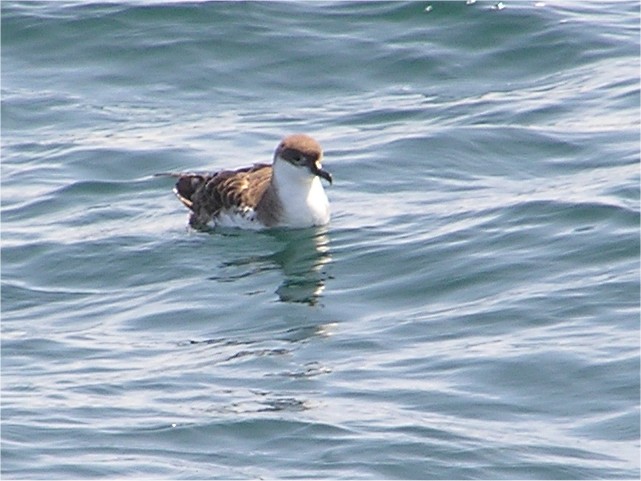
There were Greater Shearwater in abundance, many floating on the ocean near where we stopped to observe the dolphins.
I enjoyed seeing the Wilson's Storm-petrel. They flit about just over the surface of the water.
Here's another. I'd get excited when I saw these birds and proclaim, "There's one!" to Cyndi, much to the irritation of the whale watchers who would always turn to see a whale and be disappointed, again.
When there's a whale, it's hard to miss. When it is a pair of Humpback Whales, they're awesome. "Thar she blows!"
Whale tails become encrusted with barnacles and scarred by encounters with Killer Whales, so every whale has a unique tail, much as people have unique fingerprints. The tail can be used for identification. The biologist on board the tour said these two were Gemini and Triton, and Gemini was first seen in 1976, and Triton in 1981.
There they go, back to the deep to feed in the cold upwelling nutrient-rich waters of the Gulf of Maine. Click on a tail to get a closer look at the scars, bite marks, and barnacles.
We watched them for about a half-hour. They often slapped their tails forcefully against the water, and the biologist said that is presumed to be a way to communicate over great distances, and may assist in knocking some of the barnacles off. I thought they were just "marking their territory" since there was a big boat stopped next to them. Maybe it is a warning, like, "Could be whalers." It was certainly a joy to watch, and the tour ran overtime ... to our delight.
Near Petit Manan we saw Common Murre.
Sunday, September 27, 2009
Whale Watching
In Maine I went on a whale watching trip with Bar Harbor Whale Watch. I'm not one to advertise, but in case you want to go out with them, here's their website.
http://www.barharborwhales.com/default.php
As you can imagine, I dreamed of seeing pelagic (sea-going) birds. Some birds rarely come to land, except to nest. This tour boat does a trip with Audubon folks once a year where I imagine they slow the boat and correctly identify birds, but this trip was more oriented toward whales than birds. That boat can really move, and the birds were often fleeing for their very lives, like this Puffin. Sorry little guy. Didn't mean to intrude.
After we left port it wasn't 15 minutes until a Minke Whale surfaced right next to the bow where I was sitting. The boat came to a stop and the whale took another breath of air and then was gone. I have not ever been whale watching before, so it was interesting to see how the boat races from spot to spot at such a high speed, but comes to a complete stop when a whale is located. It didn't slow for birds at all, to my disappointment.


I found a lot of interesting facts about this lighthouse at the website http://www.lighthouse.cc/mountdesertrock/history.html
An excerpt from the web site advises, "Far-flung Mount Desert Rock Light is one of the most dramatically isolated of all American lighthouses. More than 20 miles from the nearest port at Mount Desert Island, the low-lying, wave swept rock is, as historian Edward Rowe Snow put it, like "part of another world." George Putnam, for many years the commissioner of the Bureau of Lighthouses, regarded Mount Desert Rock as the most exposed light station in the United States. The tiny rock is only about 17 feet above sea level at its highest point.
In this closer view you can see that it was *once again* severely damaged by a hurricane this year.

On this small rock you can see Gray Seals, Harbor Seals, and overhead a Greater Shearwater flies. There's a seal in the water at the lower right. Two Peregrine Falcons were on the island as well. It is owned by the College of the Atlantic now, and is a research station for studying whales and birds.
From this vantage point I got to see what Columbus and his crew must have viewed as they left the reassuring world of solid earth. Water all the way to the horizon. No more islands, not even a small rock. Creepy.
Looking back toward our port the mountains were beginning to sink into the sea. Certainly not a flat earth ... or perhaps we were already beginning to slip off the edge. I began to think we should return. The boat throttled up after a brief stop by this rock and headed into an area of cold, nutrient-rich upwelling water that hosted a lot of marine life.
Suddenly a fin broke the surface, then another and another. The boat stopped and we were surrounded by about 45 Pilot Whales. Like dolphins they were playful and curious. My photos are decent, but to get some really excellent images taken by the naturalist from up on the 3rd deck of this huge boat, visit the Bar Harbor Whales site on Flickr.
http://www.barharborwhales.com/default.php
As you can imagine, I dreamed of seeing pelagic (sea-going) birds. Some birds rarely come to land, except to nest. This tour boat does a trip with Audubon folks once a year where I imagine they slow the boat and correctly identify birds, but this trip was more oriented toward whales than birds. That boat can really move, and the birds were often fleeing for their very lives, like this Puffin. Sorry little guy. Didn't mean to intrude.
After we left port it wasn't 15 minutes until a Minke Whale surfaced right next to the bow where I was sitting. The boat came to a stop and the whale took another breath of air and then was gone. I have not ever been whale watching before, so it was interesting to see how the boat races from spot to spot at such a high speed, but comes to a complete stop when a whale is located. It didn't slow for birds at all, to my disappointment.When the fin of a Basking Shark broke the calm surface of the ocean the boat again throttled down for a look.

I saw three lighthouses, including this interesting one, which is the New England lighthouse farthest from shore.
I found a lot of interesting facts about this lighthouse at the website http://www.lighthouse.cc/mountdesertrock/history.html
An excerpt from the web site advises, "Far-flung Mount Desert Rock Light is one of the most dramatically isolated of all American lighthouses. More than 20 miles from the nearest port at Mount Desert Island, the low-lying, wave swept rock is, as historian Edward Rowe Snow put it, like "part of another world." George Putnam, for many years the commissioner of the Bureau of Lighthouses, regarded Mount Desert Rock as the most exposed light station in the United States. The tiny rock is only about 17 feet above sea level at its highest point.
On this small rock you can see Gray Seals, Harbor Seals, and overhead a Greater Shearwater flies. There's a seal in the water at the lower right. Two Peregrine Falcons were on the island as well. It is owned by the College of the Atlantic now, and is a research station for studying whales and birds.
Their blog is http://barharborwhales.blogspot.com/2009/09/pilot-whales-galore.html and there you'll experience their excitement at this find. More photos they took are on Flickr http://www.flickr.com/photos/bhwhales Not every whale watch sees whales, and we had a great, extended encounter.
They did really surround the boat so everybody had great views. There were big males and females with young close by their side.
This Pilot Whale seemed to come "people watching" by the side of the boat.
On the way back to port I saw more Shearwaters, and got this photo of one skimming barely above the water. Though I had hoped for more bird sightings, the many seals, porpoise, shark, and whales more than satisfied my curiosity. For sea birds, the best is to take a tour to their breeding islands. Maybe next time.
Labels:
Atlantic,
Island,
lighthouse,
Maine,
puffin,
shark,
shearwater,
whale
Subscribe to:
Posts (Atom)